
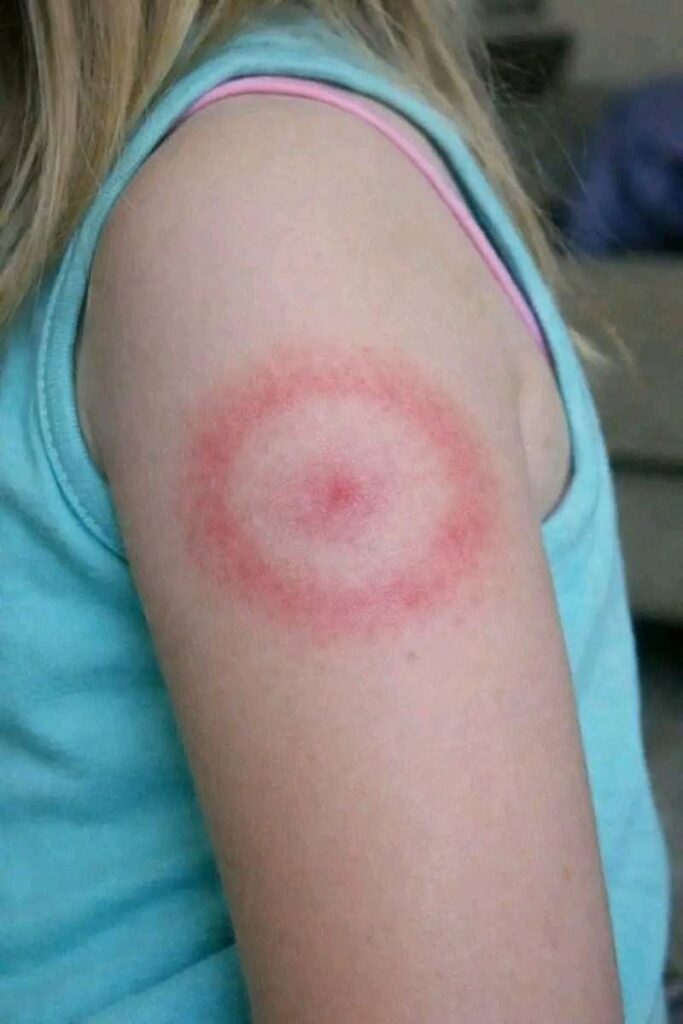
Could It Be Lyme Disease?
One of the first conditions doctors consider with an expanding ring-shaped rash is Lyme disease.
Lyme disease is caused by bacteria transmitted through infected black-legged ticks.
One of its earliest signs is a rash called erythema migrans.
Interestingly, many people expect this rash to itch or hurt.
Usually, it doesn't.
Instead, it slowly expands outward over several days.
Sometimes the middle becomes lighter, creating the famous bullseye appearance.
However, not every Lyme rash actually looks like a target.
Many appear as simple expanding red circles.
Common characteristics include:
- Slowly enlarges over days
- Usually larger than 2 inches
- Often warm
- Usually painless
- Usually not itchy
- Appears days after a tick bite
Many parents never even notice the tick.
Young ticks can be no larger than a poppy seed.
If your child recently played in:
- tall grass
- wooded trails
- campsites
- parks
- leaf piles
it's worth calling your pediatrician.
Early Lyme disease responds extremely well to antibiotics.
Ringworm: The Surprisingly Common Cause
Despite its alarming name, ringworm has absolutely nothing to do with worms.
It's actually a fungal infection.
Children commonly catch it through:
- pets
- classmates
- locker rooms
- wrestling mats
- shared towels
Ringworm typically forms a circular rash with:
- raised borders
- flaky skin
- central clearing
- itchiness
Unlike Lyme disease, ringworm almost always has a scaly appearance.
Fortunately, treatment is usually simple.
Most cases respond well to antifungal creams prescribed by a healthcare provider or available over the counter, depending on severity.
Could It Simply Be an Insect Bite?
Many insect bites trigger circular inflammation.
Mosquitoes, spiders, horseflies, and even ants can leave expanding red patches.
These usually:
- itch
- improve within days
- remain localized
- become less noticeable over time
If swelling becomes severe or breathing problems develop, seek emergency care immediately because allergic reactions can progress quickly.
Contact Dermatitis
Sometimes the cause isn't an insect or infection at all.
Children frequently develop localized skin irritation after exposure to:
- soaps
- lotions
- laundry detergents
- sunscreen
- plants
- metals
- adhesives
Contact dermatitis often follows the exact shape of whatever touched the skin.
Unlike Lyme disease, these rashes often itch intensely.
Removing the irritant usually allows healing to begin.
Pityriasis Rosea
This harmless condition often begins with one larger circular patch known as the "herald patch."
Days later, many smaller spots appear across the chest and back.
Although it looks alarming, pityriasis rosea usually resolves on its own within several weeks.
Doctors still don't know its exact cause, although it's thought to follow certain viral infections.
Granuloma Annulare
Parents are often surprised to learn about granuloma annulare.
This completely benign skin condition produces smooth rings that:
- usually don't itch
- aren't painful
- develop slowly
- may persist for months
Doctors don't always know why it develops.
Many cases disappear without treatment.
Nummular Eczema
Some eczema patches become perfectly round.
Unlike ringworm, however, these patches tend to:
- itch intensely
- ooze occasionally
- become extremely dry
- crack
Moisturizers and prescription creams usually help significantly.
When Should Parents Call the Pediatrician?
Most ring-shaped rashes don't require an emergency room visit.
However, you should contact your child's doctor within the next day if:
- the rash continues growing
- fever develops
- your child feels tired
- recent tick exposure occurred
- multiple rings appear
- the rash lasts several days
- pain develops
- pus appears
- swelling increases
Doctors may ask you to send photographs through the patient portal before scheduling an appointment.
When Is It an Emergency?
Although uncommon, certain symptoms should never wait.
Seek emergency medical care immediately if the rash occurs together with:
- difficulty breathing
- facial swelling
- swollen tongue
- severe headache
- stiff neck
- confusion
- purple bruising
- high fever
- persistent vomiting
- extreme lethargy
These symptoms could indicate a much more serious illness requiring immediate treatment.
What the Doctor May Do
Depending on the appearance of the rash, your pediatrician may:
- examine the skin
- review recent outdoor activities
- ask about tick exposure
- inspect pets
- evaluate for fungal infection
- prescribe antibiotics
- recommend antifungal medication
- monitor progression
Most diagnoses can be made simply by examining the rash.
Blood tests are not always necessary, especially during early Lyme disease.
Preventing Tick Bites
If Lyme disease concerns you, prevention remains the best strategy.
Whenever children spend time outdoors:
- wear long sleeves
- tuck pants into socks
- stay on cleared trails
- use insect repellent
- check the entire body afterward
Pay special attention to:
- behind ears
- scalp
- groin
- knees
- underarms
- waistline
Ticks often hide in warm skin folds.
Removing attached ticks promptly significantly reduces transmission risk.
Caring for Your Child While Waiting for an Appointment
If your child feels well, keep the area clean and dry.
Avoid:
- scratching
- heavy creams
- unnecessary antibiotic ointments
- harsh disinfectants
Continue observing.
Take additional photographs if changes occur.
If itching develops, ask your pediatrician before applying medicated creams because certain treatments can change the appearance of the rash and complicate diagnosis.
Frequently Asked Questions
Can Lyme disease occur without seeing a tick?
Yes.
Most parents never find the tick.
Young ticks are incredibly tiny and often detach before anyone notices them.
Is every bullseye rash Lyme disease?
No.
Several skin conditions mimic the classic target appearance.
A medical evaluation is the best way to determine the cause.
Is ringworm dangerous?
No.
Although contagious, ringworm is generally a mild fungal infection that responds well to treatment.
Can children continue attending school?
That depends on the diagnosis.
Children with treated ringworm can often return to school quickly, while Lyme disease is not spread from person to person.
Always follow your healthcare provider's recommendations.
Should I cover the rash with a bandage?
Usually no.
Allowing the skin to breathe often promotes healing unless your healthcare provider instructs otherwise.
The Emotional Side of Parenting
Every parent knows that moment.
You notice something unusual.
Your stomach drops.
Within minutes you've imagined every frightening possibility.
The internet can make that anxiety even worse.
Remember this:
Concern doesn't mean panic has to take over.
Observing carefully, documenting changes, and contacting your child's healthcare provider are often the most helpful steps you can take.
Most childhood rashes have straightforward explanations and effective treatments.
Children are remarkably resilient.
Even conditions like Lyme disease, when recognized early, are highly treatable with antibiotics.
Final Thoughts
Finding a mysterious red ring on your child's arm can be frightening, especially when it seems to grow larger over time.
While Lyme disease is certainly one possible explanation, many other conditions—including ringworm, insect bites, eczema, contact dermatitis, granuloma annulare, and pityriasis rosea—can produce similar circular rashes.
Instead of immediately assuming the worst:
- Stay calm.
- Take clear photographs.
- Watch for changes.
- Monitor for additional symptoms.
- Contact your pediatrician if the rash expands or if your child becomes ill.
Most importantly, trust your instincts as a parent. You know your child better than anyone else. If something doesn't feel right, seeking medical advice is always the right decision.
Early evaluation provides peace of mind—and when treatment is needed, it usually leads to the best possible outcome.
A strange red ring is a reason to pay attention, not necessarily a reason to panic. With careful observation and timely medical guidance, most children recover quickly and return to being happy, healthy, and carefree.

Leave a Reply